
LOGISTICS UNDER CONTROL. COSTS UNDER CONTROL.
Internal Logistics Optimization
Discover reserves in warehouse and production processes. Get an overview of material flow, worker utilization, and opportunities to reduce logistics costs.

MEASUREMENT AND ANALYSIS
Find out how logistics really works.
CAPACITIES AND UTILIZATION
Check whether people and equipment are used efficiently.
SPECIFIC SOLUTIONS
Make decisions based on data and economics.
WHEN OPTIMIZATION MAKES SENSE
Do you feel that logistics could operate more efficiently?
Growing volumes, changing production requirements, and daily operations often cause logistics processes to evolve gradually – without a comprehensive overview of their true efficiency. The result can be unnecessary transfers, unused capacity, or unbalanced workloads.
Unnecessary transfers and empty runs
Trucks and workers take routes that do not bring direct value. Material is moved repeatedly or waits for the next step.
Unclear worker utilization
It is not easy to determine how much capacity individual activities actually require and whether the number of workers is set appropriately.
Overloaded or unbalanced shifts
During peak hours, bottlenecks and delays occur, while in other parts of the shift capacity remains unused.
Decision-making without sufficient data
When planning shifts or automation, an accurate picture of volumes, routes, times, and costs is missing.
WHAT YOU GET
An overview that helps you make better decisions
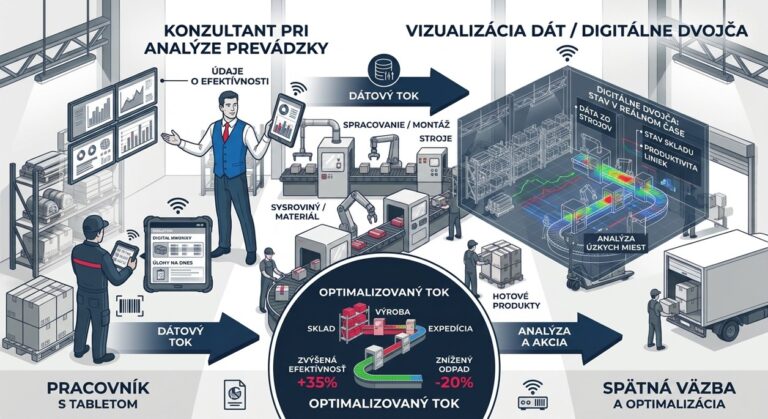
Internal logistics optimization connects the measurement of actual operations with the evaluation of capacities and the proposal of specific measures. The output is not just a list of problems, but a basis for deciding what to change, in what order, and with what expected benefit.
Material flow overview
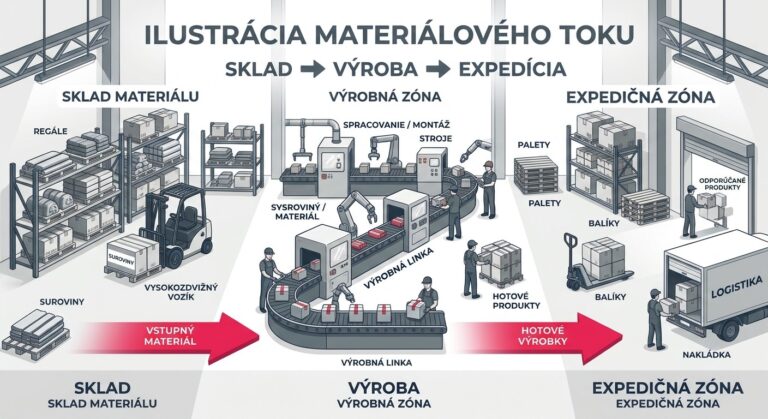
You will get a mapping of material movement between the warehouse, production, and individual delivery points. You will identify unnecessary routes, waiting times, repeated handling, and bottlenecks.
Capacities and Workload
You will evaluate the time requirements of activities, the workload of individual shifts, and staff requirements based on actual work volume, peak times, and operating conditions.
Optimization Options
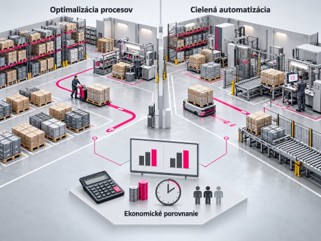
You will receive proposals for adjusting routes, replenishment, workflows, activity layout, and work organization. Measures with lower investment requirements can be explored first.
Basis for automation
If automation is appropriate, the analysis will help determine which transport processes have potential for AMR/AGVs, conveyors, or digital management of transport requests.
WHAT IS THE PROCESS
From understanding the current state to an actionable plan
01 Current State Analysis
We will familiarize ourselves with the operation, layout, material flows, equipment used, job roles, and available data. We will verify how processes are set up in practice.
02 Measurement and Data Collection
We monitor selected activities and work cycles, transfer times, waiting times, empty runs, and shift workloads. We supplement the data with interviews and available ERP/WMS data.
03 Evaluation and Capacity Model
We will evaluate the time requirements of individual activities, utilization, staffing needs, and differences between shifts. We will create a basis for assessing capacity reserves.
04 Proposal of Solution Variants
We will prepare options for process optimization and, where appropriate, targeted automation solutions. We will assess them from the perspective of operations, technical conditions, and feasibility.
05 Economics and Action Plan
We will compare expected savings, new operating costs, and investments. The result will be a recommendation of next steps and a basis for the implementation decision.
Project Outputs
You will receive materials you can work with
The results of the analysis are processed in such a way that you can use them in the daily management of operations as well as in planning future investments.
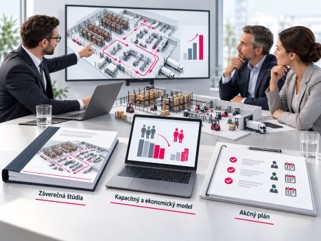
Final Study
Overview of the current state, identified losses, process evaluation, and recommended solution variants in a clear presentation.
Capacity and Economic Model
Computational basis with evaluation of times, utilization, staffing needs, potential savings, investment and operating costs.
Action Plan
Recommended steps sorted by benefit and feasibility to help you determine priorities and the next course of action.
Presentation of Results
Summary of findings and recommendations for the project team and decision-makers in your company.
Project Experience
Concrete results from optimization and automation
The following examples are based on project references. The achieved results are tied to the specific conditions of individual operations.
60 %
space savings after rearranging production halls
45 %
reduction of internal transport costs
25 %
reduction of inventory in the production project
90 %
storage space utilization in an automated warehouse
Manufacturing company – hall layout reorganization By connecting two production halls into a more functional unit, it was possible to reduce the required floor space by 60%, lower internal transport costs by 45%, and eliminate the rental of one hall.
Manufacturing company – optimization of production processes – The project resulted in a 15% increase in OEE, a 10% improvement in quality, a 25% reduction in inventory, and a 25% improvement in OTD.
Central spare parts warehouse – The solution achieved a 98% level of storage and handling security, 95% utilization of logistics equipment, and a 95% level of human resource utilization strategy.
Automated warehouse – In the automated warehouse project, 90% storage space utilization was achieved.
Manufacturing company – logistics layout design – The logistics solution was designed to accommodate a planned 30% increase in production next year and verified by simulation. This represents planned capacity, not a declared achieved increase in production.
Let's begin with the initial consultation
Don't you know where the biggest losses occur in your logistics?
Discuss your operation, current challenges, and opportunities for improvement with us. Together, we will clarify which areas make sense to review and what approach can be beneficial for your company.
- Space to present your logistics processes and problems
- Preliminary assessment of areas with potential for improvement
- Recommendation of a suitable next step
Without any obligation to order a complete logistics study
FREQUENTLY ASKED QUESTIONS
What you should know before getting started
How long does it take to process a logistics study?
The estimated processing time is approximately 4 to 6 weeks. The specific schedule depends on the scale of the operation, the availability of data, and the possibility of conducting measurements across individual shifts.
What data needs to be prepared?
Data on income, expenses, and material transfers by shifts, information on equipment, work roles, shift patterns, layout, routes, capacities, and operational constraints will help. Available exports from ERP or WMS can also be utilized.
Is it possible to optimize logistics even without automation?
Yes. Process measures, such as adjusting routes, replenishment, working procedures, batching, or task distribution, are also part of the assessment. Automation is not an automatic goal.
How do I know if automation is suitable for us?
The analysis will assess the nature and repeatability of transport operations, handling units, aisle widths, floor condition, safety conditions, and integration options. Based on this, the potential of AMR/AGV solutions or other technologies can be evaluated.
What will be the result of the cooperation?
Final presentation, capacity and economic model, recommended solution variants, and an action plan. The results will help you compare the benefits and costs of individual options.
Leave us your contact information and together we will review your logistics processes, current challenges, and optimization opportunities. The initial consultation is non-binding and will help you navigate your next options.
By submitting the form, you express interest in being contacted regarding your request. The initial consultation is non-binding.